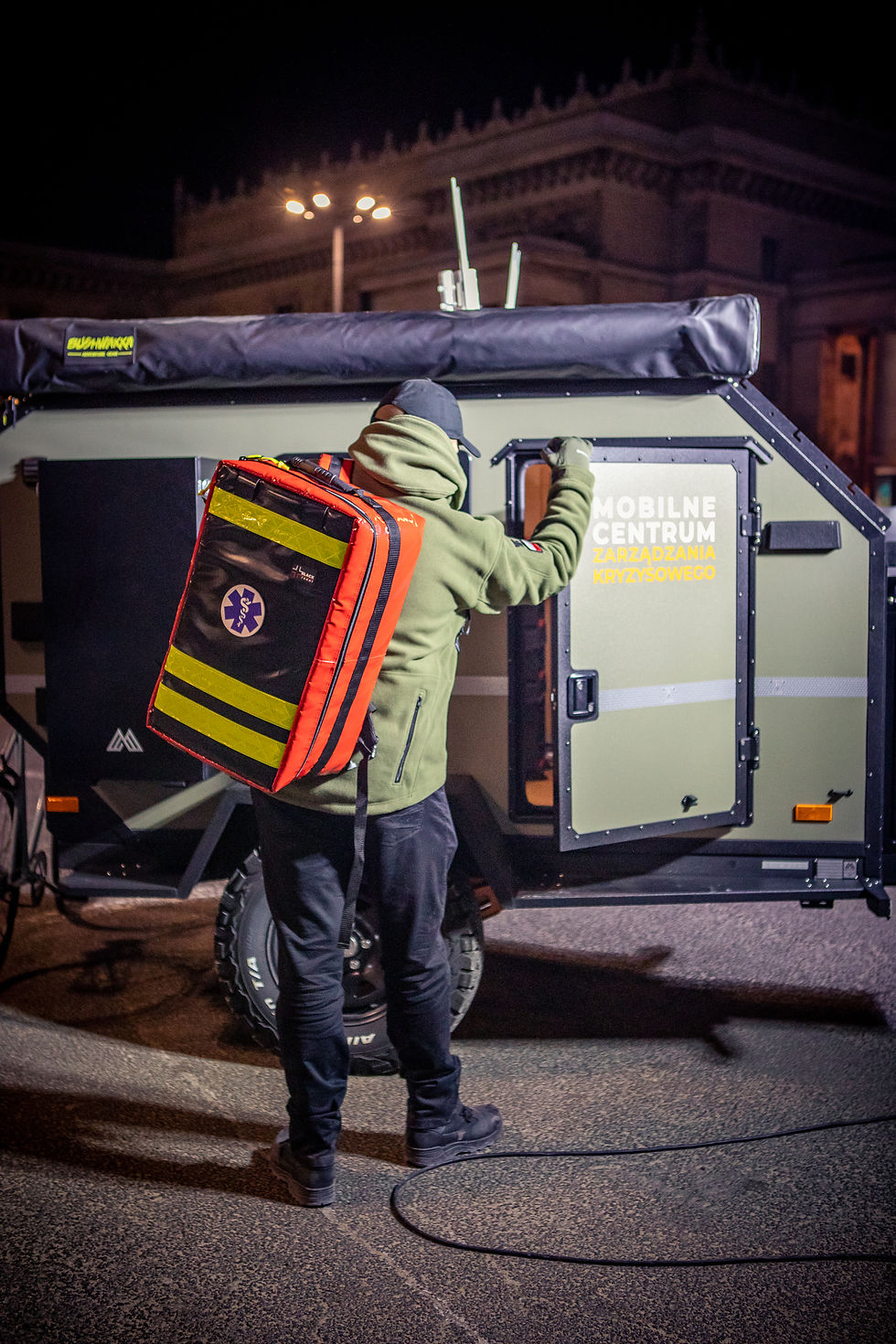
Mobile command in practice.
- Michał Lorenc

- Apr 30
- 4 min read
Use of the CELiUS ARCA off-road trailer in crisis management.

From Plans to Real Operational Capability
Modern crisis management is increasingly moving away from a model based solely on procedures and planning documents. In its place, an approach focused on real operational capabilities is emerging-capabilities that can be deployed immediately in dynamic and often unpredictable environments. Crises rarely unfold according to predefined scenarios. In practice, this means operating with limited infrastructure availability, disrupted communication, and time pressure that leaves no room for improvisation. In this context, the role of mobile command and management infrastructure is becoming increasingly significant-not as a supplementary system, but as an integral component of it. The CELiUS ARCA off-road command support trailer was designed precisely within this paradigm: as a tool that brings command capability directly to the incident site, regardless of the conditions in which operations must be carried out.
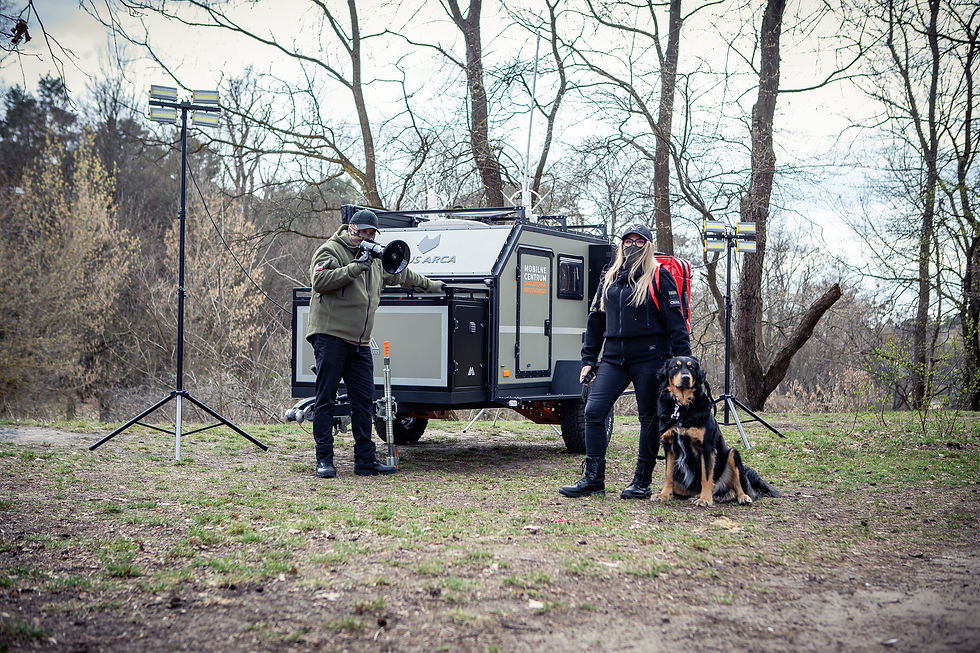
Mobile Operational Center as a System Component
The CELiUS ARCA trailer is not a hardware solution in the conventional sense. Its value does not stem solely from its equipment, but from the role it plays within the architecture of crisis management. In practice, it functions as a mobile command post capable of assuming or supporting operational functions when fixed infrastructure loses availability or effectiveness.
The core design principle was to ensure full operational autonomy. This includes both energy independence and the ability to maintain communication across multiple channels simultaneously. In crisis environments, the loss of either of these elements can rapidly lead to a loss of control over the situation. For this reason, the solution was equipped with redundancy at both the power supply and communications levels, enabling continued operational capability even in cases of partial system degradation. An equally important aspect is the mobility of the solution itself. The ability to relocate the command post directly to the vicinity of an incident significantly reduces response times and improves decision-making quality. Access to real-time information, direct situational awareness, and immediate contact with operational teams translate into greater effectiveness-particularly during the critical initial phase of a crisis.

Digital Integration as a Condition for Effectiveness
One of the most common challenges in crisis management is fragmented information and the lack of a unified communication environment. Even the most advanced forward command post loses value if it cannot ensure efficient data flow between all operational participants. For this reason, CELiUS ARCA is designed to integrate with the CELiUS mobile application, which functions as a digital operational umbrella during crisis response. This integration is what creates the solution’s strategic advantage. The trailer is not merely a physical support structure. It is part of a broader ecosystem in which data, communication, and decision-making operate within one coherent environment. In practice, this means that command staff operations can be conducted in real time regardless of participants’ physical locations. Information transmitted from the field can be analyzed immediately, while decisions can be distributed to relevant teams without delays caused by communication limitations. This operating model significantly reduces the risk of errors resulting from incomplete or outdated information - one of the primary causes of operational inefficiency during crisis situations.

Operational Scenario
To better illustrate the practical application of this solution, consider a scenario involving industrial infrastructure failure combined with the need to evacuate part of an area and coordinate multiple agencies. In such a case, a standard crisis management center may be located outside the direct impact zone, limiting its ability to respond quickly. Deploying the CELiUS ARCA mobile operational unit enables the establishment of a forward command post in immediate proximity to the incident. Within the first hours, independent power supply can be secured, multi-channel communication can be activated, and operational teams can be integrated into one unified management environment. Using the CELiUS mobile application, field teams report developments in real time, transmitting data directly to the operational command staff located in or near the trailer. At the same time, communication with central command units and other emergency services can be maintained through independent communication technologies. This structure allows operational strategies to be continuously adapted to evolving conditions while ensuring effective resource management. Importantly, the mobility of the solution enables relocation as the incident develops. Even in the most challenging terrain. Unlike fixed infrastructure, which is constrained by location, the CELiUS ARCA off-road trailer can move with the dynamics of the crisis, maintaining continuity of command and communication.

The Role of Mobile Units in Building Resilience
From a systemic perspective, mobile operational units now serve a function that was marginalized only a few years ago. They are no longer viewed as emergency-only solutions, but as one of the key pillars of modern security architecture. Their importance stems from the fact that contemporary threats increasingly result in infrastructure-level disruptions affecting energy systems, communications, and access to information networks. Lessons from the Ukrainian frontline reinforce this reality. Under such conditions, operational continuity is determined not by the quality of plans alone, but by the availability of tools capable of executing those plans. CELiUS ARCA fits this model as a solution that combines mobility, autonomy, and digital integration to create a coherent operational environment independent of external conditions. Building societal and institutional resilience is not solely about preparing response scenarios. It is about ensuring the practical ability to function under disruption. Mobile command units such as CELiUS ARCA represent one of the most direct and measurable manifestations of that capability.

Direction of Development
The evolution of solutions such as CELiUS ARCA clearly demonstrates that the future of crisis management will be based on the integration of physical and digital components. IT systems, while essential, are insufficient without infrastructure capable of enabling their deployment in the field. Conversely, infrastructure without a digital layer cannot provide effective information management. Only the combination of these two elements creates an environment capable of meeting the demands of modern crises. CELiUS ARCA is an example of this approach, a solution designed not as a standalone product, but as part of a larger operational ecosystem whose purpose is to ensure continuity of operations under the most demanding conditions.